
 100% Made in Italy


Specifying the motion component inside a vending machine is a load, duty-cycle, and envelope problem before it is anything else. The actuator has to move the correct load, within the available stroke and cabinet depth, at a duty cycle that matches how often the machine dispenses and it has to keep doing so for millions of cycles without a service call. Radia has manufactured electromechanical linear drives in Italy for 35 years, and the LATT and LAT actuator series are specified into vending and automated retail machines precisely because their thrust, speed, and duty-cycle data are published and repeatable across production runs. This reference sets out the technical basis for specifying Radia actuators into vending machine mechanisms, drawing on the published data for the LATT telescopic actuator series and the wider Radia product range.
Product references Product references: radiamotion.com/en/attuatori-telescopici-latt · radiamotion.com/en/prodotti
Why the Actuator Is the Critical Component in Vending Machine Design
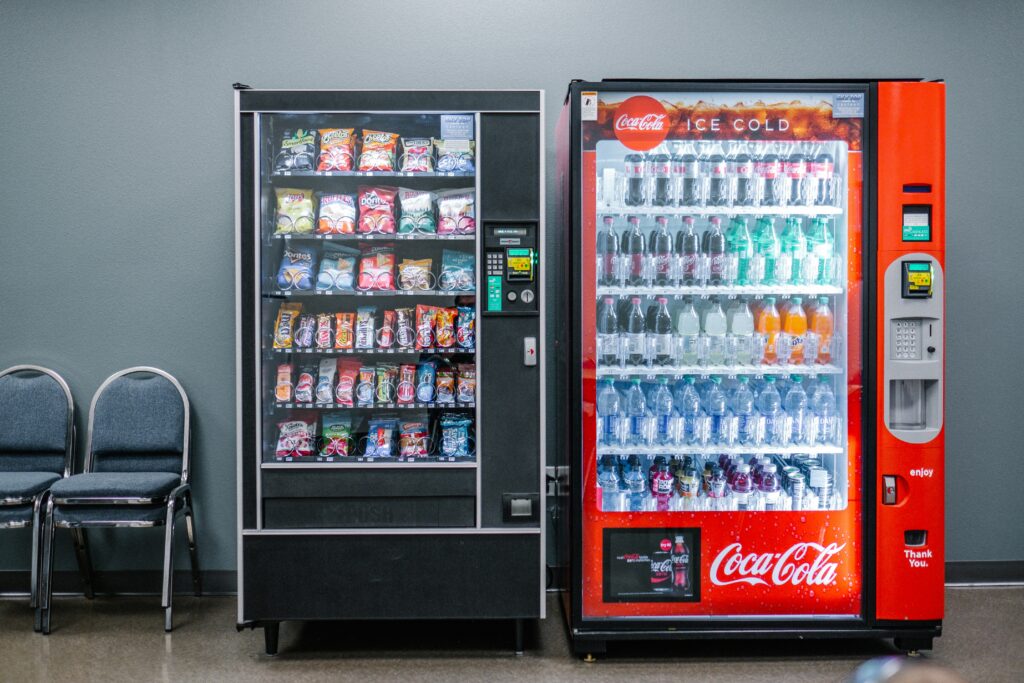
Every automated dispensing cycle in a modern vending machine pushing a product forward, lifting a platform, rotating a tray, releasing a locked door reduces to a linear or rotary motion event driven by an actuator or gearmotor. Unlike a generic DC motor, a linear actuator integrates the motor, gear reduction, and lead screw or spindle into a self-contained unit that converts rotary drive directly into controlled straight-line thrust. For an OEM, that means fewer parts to specify, tolerance-stack, and mount inside an already dense cabinet. The engineering trade-off is between speed, load, and duty cycle: a higher gear reduction increases thrust but reduces travel speed and the duty cycle the motor can sustain without overheating. Getting this trade-off wrong is the most common cause of field failures in unattended retail equipment, which is why actuator selection should start from the manufacturer's rated tables rather than a generic "linear actuator" datasheet.
The LATT series is produced with six standard strokes, ranging from 50 mm to 300 mm, and covers nominal loads from approximately 70 N (for the lightest gear ratio) up to 3640 N (for 24 V DC variants with the highest reduction ratio). Stroke and load can be customized beyond these standard ranges to suit specific unit geometries.
The LATT series is produced with six standard strokes, ranging from 50 mm to 300 mm, and covers nominal loads from approximately 70 N (for the lightest gear ratio) up to 3640 N (for 24 V DC variants with the highest reduction ratio). Stroke and load can be customized beyond these standard ranges to suit specific unit geometries.
What is the difference between the LATT and LAT actuator series?
The LATT is the telescopic version of the LAT, sharing the same electromechanical thrust and speed characteristics but housed in an aluminium sleeve and stem for a more compact, self-protecting envelope. LAT is typically selected when a fixed, non-telescoping housing suits the mechanism; LATT is preferred where the retracted length must be minimised inside the cabinet.
How is the duty cycle defined for actuators used in high-frequency distribution cycles?
Duty cycle on the LATT range is defined per amperage class and voltage: for example 90% ON / 10% OFF at 12V on the 0.5A models, down to 20% ON / 80% OFF on the higher-torque 2A and 4A models. Engineers should select the gear ratio and amperage class against the actual on-time per dispensing cycle rather than assuming a single duty-cycle figure across the range.
What position feedback and control options are available for Radia actuators?
LATT actuators can be specified with a Hall-effect encoder for position and direction feedback, a thermal protector, and one of several electronic control modules, including limit-switch modules and the RADIA SMC and MINI-SA control modules, for direct integration with vending machine controller boards.
What is the nominal operating temperature range for Radia actuators?
The LATT and LAT ranges are rated for an operating temperature window of -20°C to +85°C, which covers both refrigerated retail cabinets and the elevated ambient temperatures found near hot food and cooking modules.
Is it possible to customize Radia actuators based on the specific dimensions of the vending machine enclosure?
Yes. While the LATT ships in six standard strokes, Radia engineers custom stroke lengths, mounting interfaces, and electrical configurations to match a specific cabinet envelope, and can advise on gear ratio selection for a target load and cycle time.